
Artificial intelligence is changing the way people discover information, compare products, and make buying decisions. For years, digital advertising has been dominated by search engines, social media, and e-commerce platforms. Now, conversational AI is creating another layer of digital discovery—where users can explain what they need in natural language and receive contextual answers.
This shift is particularly important for India. According to FICCI-EY, India’s digital advertising market grew 26% in 2025 to ₹94,700 crore, accounting for about 63% of total advertising revenue. As businesses continue moving budgets toward measurable digital channels, the emergence of AI-based advertising is attracting significant attention.
LETS EXPLORE THIS BLOG WITH GROWWITHSURENDER
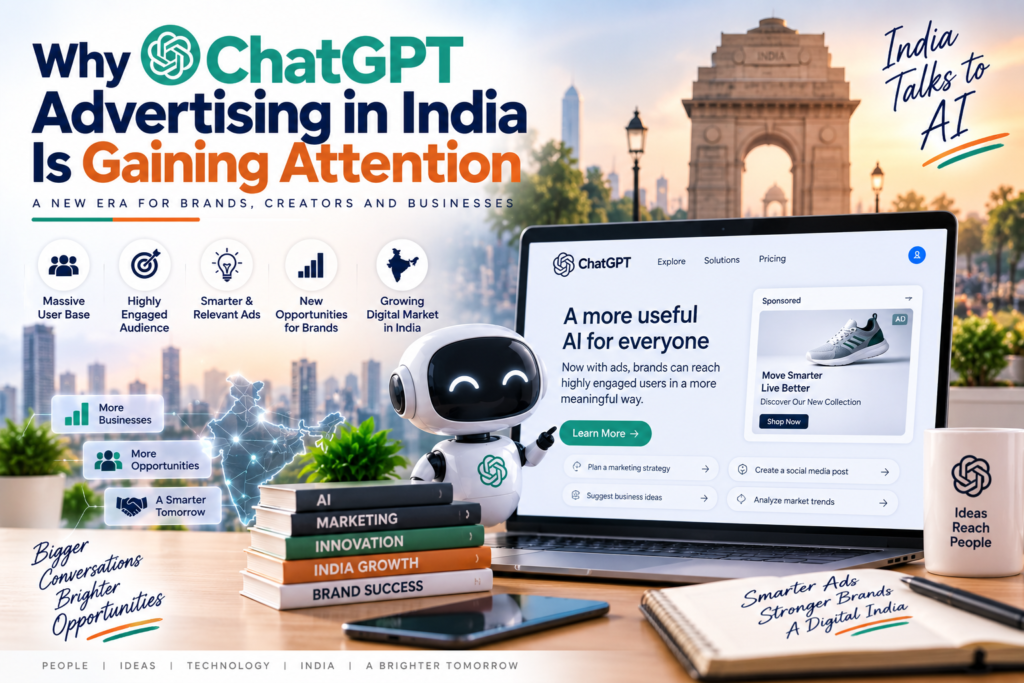
The launch of ChatGPT Ads in India makes this trend much more tangible for Indian marketers. OpenAI began rolling out ads to logged-in adult users on its Free and Go plans in India on August 27, 2026, while Plus, Pro, Business, Enterprise, and Education users remain ad-free.
The scale of the opportunity is substantial. ChatGPT had approximately 330 million unique monthly users in India in May 2026, up from 297 million in December 2025, according to Business Standard citing Bloomberg data. This gives ChatGPT Ads in India access to a large audience already using AI for research, planning, comparisons, learning, and everyday decisions.
OpenAI says its advertising system places ads based on the context of a user’s conversation and keeps advertisements clearly separated from ChatGPT’s answers. It also states that advertisers do not receive access to users’ private conversations.
What Indian Businesses and Marketers Should Know
For businesses, ChatGPT Ads in India is more than another advertising placement. It represents a potential shift from keyword-driven advertising toward conversation- and intent-driven discovery. A customer might describe a problem, compare alternatives, or ask for recommendations before ever visiting a company’s website.
OpenAI has also expanded its advertising infrastructure beyond an initial pilot. In August 2026, it announced that self-service Ads Manager access was expanding to India, alongside new targeting, measurement, product-feed, and conversion capabilities.
For Indian marketers, ChatGPT Ads in India therefore deserves attention alongside existing channels such as Google Ads, Meta Ads, SEO, and content marketing. The opportunity is still developing, but one thing is already clear: AI is becoming part of the advertising and customer-discovery journey, not simply a tool marketers use behind the scenes.
What Is ChatGPT Advertising?
ChatGPT advertising is a new form of AI-powered advertising built around the way people use conversational AI to research, compare, and make decisions. Instead of entering a short keyword into a search engine, users can describe a complete need in a conversation. This gives advertisers a richer context for presenting relevant products or services.
For Indian businesses, ChatGPT Ads in India became a real advertising channel in August 2026. OpenAI began showing ads to eligible adult users on its Free and Go plans in India, while Plus, Pro, Business, Enterprise, and Education users remain ad-free. India is also a significant market for ChatGPT, with 330 million unique monthly users reported in May 2026, up from 297 million in December 2025.
Understanding AI-Powered Advertising
Traditional digital advertising generally depends on signals such as keywords, interests, demographics, browsing behavior, or social activity. ChatGPT Ads in India [RESOURCES: https://en.wikipedia.org/ ] introduces a more conversational approach. OpenAI says its advertising system considers the context and intent of the current conversation and, where personalization is enabled, selected signals from a user’s broader ChatGPT experience.
For example, someone researching laptops might ask several questions about performance, budget, battery life, and specific use cases. An advertisement can potentially appear in that relevant conversational environment rather than simply being triggered by one keyword.
How Is It Different From Traditional Online Advertising?
One important distinction with ChatGPT Ads in India is the environment in which the advertisement appears. ChatGPT ads are displayed below ChatGPT responses, clearly labeled as sponsored, and visually separated from the organic answer. OpenAI states that advertisements do not influence the answers provided by ChatGPT.
The advertising model also supports familiar performance objectives. Advertisers can currently choose campaigns focused on views (CPM), clicks (CPC), or conversions, while Ads Manager provides metrics such as impressions, clicks, CTR, CPC, CPM, and conversions.
The Role of Conversational AI
This is where ChatGPT advertising in India becomes particularly interesting for marketers. A conversation can reveal what a person is trying to accomplish, the constraints they have, and the alternatives they are considering.
OpenAI describes this as an environment where discovery, consideration, and decision-making can happen within one experience.
The next evolution could go beyond a conventional ad. OpenAI is currently testing Sponsored Agents, which allow users to start a conversation with a business-sponsored AI agent after clicking an advertisement.
For marketers, ChatGPT Ads in India therefore represents a shift toward advertising built around conversation, context, and intent—potentially making AI a new part of the customer journey rather than simply another place to display a banner or sponsored link.
ChatGPT Ads India: Why Is India Important?
India has become one of the most important digital markets for businesses, and the rapid adoption of artificial intelligence is adding another layer to that growth. In 2025, India’s digital advertising market grew 26% to ₹94,700 crore, accounting for 63% of total advertising revenue, according to the FICCI-EY Media & Entertainment report. This shows how quickly Indian brands are shifting their attention and budgets toward digital channels.
Against this backdrop, ChatGPT Ads in India arrives at a particularly interesting time. ChatGPT reportedly had around 330 million unique monthly users in India in May 2026, up from 297 million in December 2025. That makes India one of ChatGPT’s largest markets and gives advertisers access to a substantial audience already using conversational AI.
India’s Growing Digital Audience
India’s digital advertising ecosystem is no longer limited to large technology companies and national brands. The FICCI-EY data shows that more than ₹36,300 crore of digital advertising revenue in 2025 came from over one million small, medium and long-tail advertisers.
That matters for ChatGPT Ads in India because the potential audience of advertisers extends well beyond multinational companies. E-commerce businesses, startups, local brands, agencies, education companies, travel businesses, and service providers could all potentially explore AI-based advertising as the market develops.
Increasing Adoption of AI Tools
India’s AI usage is growing rapidly. Preliminary Sensor Tower estimates reported by Business Standard indicate that Indian users were projected to spend 5.82 billion hours on generative-AI apps during the first half of 2026, compared with 1.66 billion hours during the same period in 2025.
This growing engagement is important because people are increasingly using AI not only to find information but also to compare alternatives, research products, plan activities, and make decisions. That creates a different environment for advertising—one based more heavily on conversation and context.
Opportunities for Indian Brands and Advertisers
The arrival of ChatGPT Ads in India gives businesses another potential way to reach consumers during these decision-making moments. OpenAI says advertisers can use Ads Manager to create campaigns, set budgets and goals, select countries, and measure performance through metrics such as impressions, clicks, and conversions. India is currently listed as a country with self-service Ads Manager availability.
For marketers, ChatGPT Ads in India could therefore become part of a broader digital strategy alongside Google Ads, Meta Ads, SEO, and content marketing. OpenAI describes the platform as an advertising environment built around conversation, context, and real-time decisions.
With India’s huge digital audience and rapidly increasing AI adoption, ChatGPT Ads in India represents an important new development for brands watching where digital advertising is heading next.
OpenAI Ads in India: What Do We Know?
The arrival of OpenAI ads in India marks a significant development in the country’s digital advertising ecosystem. OpenAI began rolling out ChatGPT Ads to logged-in adults using the Free and Go plans in India in August 2026. Users on Plus, Pro, Business, Enterprise, and Education plans continue to have an ad-free experience. Ads are designed to appear below ChatGPT responses and are clearly labelled as sponsored content.
OpenAI’s Advertising Developments
The development of ChatGPT Ads in India follows an earlier advertising pilot that OpenAI gradually expanded into additional markets. The company has since introduced a self-serve Ads Manager, allowing businesses to create campaigns, set budgets and bids, upload creatives, manage campaigns, and review performance. OpenAI’s latest announcement says advertisers can now purchase ChatGPT ads directly through Ads Manager in India.
The platform supports different campaign objectives, including views, clicks, and conversions. Advertisers can monitor metrics such as impressions, clicks, CTR, CPC, CPM, and conversions.
Advertising Partnerships and the Ecosystem
A major part of ChatGPT advertising in India is the emerging agency ecosystem. During the Indian rollout, OpenAI worked with WPP and Omnicom as initial agency partners. Reports at launch indicated that more than 50 brands were preparing to advertise on ChatGPT in India. The agency arrangement was described as non-exclusive, allowing OpenAI to work with additional partners as the program develops.
Globally, OpenAI has also collaborated with agencies including Dentsu, Omnicom, Publicis, and WPP, alongside technology partners such as Adobe, Criteo, Kargo, Pacvue, and StackAdapt.
What Is Confirmed vs. What Is Still Developing?
Several elements of ChatGPT Ads in India are now confirmed: advertising is available to eligible users, businesses can access Ads Manager, ads are separated from ChatGPT’s answers, and advertisers receive campaign-level performance data. OpenAI also says advertisers do not receive access to users’ private conversations or personal details.
At the same time, the ChatGPT advertising platform is still evolving. OpenAI is testing new AI-powered advertising experiences, including Sponsored Agents in the United States, while expanding integrations with tools such as HubSpot and Shopify. These developments show where the wider ecosystem may be heading, but they should not automatically be treated as features already available to every Indian advertiser.
For businesses watching OpenAI ads in India, the key takeaway is that this is no longer simply an advertising experiment. The platform is becoming a structured advertising channel, while its formats, partnerships, tools, and capabilities continue to develop.
ChatGPT Advertising Platform: How Could It Work?
The ChatGPT advertising platform is designed around a simple difference from traditional advertising: instead of relying only on a keyword or a demographic profile, it can use the context of a user’s conversation and their intent to determine which ads may be relevant. OpenAI says its advertising system considers signals such as the current conversation, ad copy, landing page, advertiser-provided context hints, and—when personalization is enabled—selected signals from a user’s broader ChatGPT experience.
For businesses exploring ChatGPT Ads in India, this creates a new advertising environment where a customer might encounter a brand while actively researching a product, comparing alternatives, or deciding what to do next.
Potential Ad Formats
Currently, a ChatGPT ad includes the advertiser name, logo/favicon, headline, description, landing-page link, and an image creative. Ads appear below ChatGPT responses and are clearly separated from the AI-generated answer.
This makes ChatGPT Ads in India visually different from a conventional search advertisement or social-media post. OpenAI also recommends creating multiple variations of titles and descriptions so its system can identify opportunities where different messages may be relevant.
Context and User Intent
One of the most important features of the ChatGPT advertising platform is contextual matching. Advertisers can provide “context hints” describing the conversations, topics, or keywords where their products may be useful. These hints guide ad matching but are not traditional exact-match keywords.
Imagine someone asking ChatGPT for help choosing a laptop for video editing. An advertisement for relevant software or hardware could potentially appear in that conversation because the user’s intent and context indicate a relevant need.
Audience Targeting
ChatGPT Ads in India also provide traditional campaign controls alongside AI-driven relevance. Advertisers can select countries, supported platforms, campaign objectives, and optional custom audiences. Custom audiences can be created from customer or prospect lists and used for inclusion or exclusion.
This combination means advertisers can define where a campaign should run while the system helps determine when an ad is contextually relevant.
Measurement and Performance Tracking
Measurement is another important part of the ChatGPT advertising platform. Ads Manager currently reports impressions, clicks, spend, CTR, average CPC, average CPM, and conversions when conversion tracking is configured.
Campaigns can use Views (CPM), Clicks (CPC), or Conversions objectives. Conversion-optimized campaigns can optimize toward actions such as purchases, sign-ups, or lead submissions, depending on the supported conversion setup.
For Indian marketers, ChatGPT Ads in India therefore combines familiar performance marketing concepts with something relatively new: advertising within a conversational environment where context and user intent can play a central role in ad relevance.
ChatGPT Ads Launch India: What Could Change?
The ChatGPT Ads launch India is creating a new category within the country’s digital advertising market. OpenAI launched ChatGPT Ads for logged-in adults using its Free and Go plans in India on August 27, 2026, followed by self-service Ads Manager access on September 4. More than 50 brands were expected to begin advertising during the initial Indian rollout, with WPP and Omnicom among the first agency partners.
New Opportunities for Advertisers
The ChatGPT Ads launch India gives advertisers another environment in which to reach potential customers. Unlike traditional advertising, where users may encounter an ad while searching a keyword or scrolling through a social feed, ChatGPT users often arrive with a specific question, problem, or decision to make.
OpenAI describes this as an opportunity to reach people while they explore options, compare choices, and make decisions. Its advertising platform now supports campaign objectives including views, clicks, and conversions, while CPC and outcome-optimized bidding have become important parts of the platform.
For smaller Indian businesses, accessibility is another potential change. At launch, self-service campaigns were reported with daily budgets starting at ₹725, making the platform potentially accessible beyond large brands and major agencies.
Changes in Customer Discovery
The ChatGPT Ads launch India also reflects a broader change in how consumers can discover products and services. Instead of starting with a short search query such as “best running shoes,” a user can explain their budget, preferences, intended use, and concerns in a single conversation.
OpenAI says its ads system uses the context of the current conversation to show relevant advertising, while keeping advertisements clearly separated from ChatGPT’s answers.
That creates a potentially different customer journey:
Question → Research → Comparison → Advertisement → Action
For brands, being present during this research stage could become increasingly important.
Impact on Digital Marketing Strategies
The ChatGPT Ads launch India does not mean businesses should abandon Google Ads, Meta Ads, SEO, or content marketing. Instead, marketers may need to add conversational AI to their broader acquisition strategy.
Creative teams may need to focus more heavily on clear value propositions, while SEO and content teams should continue building authoritative websites and useful information. Advertisers will also need to understand how conversational context affects relevance and conversion.
OpenAI’s Ads Manager already provides metrics such as impressions, clicks, CTR, CPC, CPM, and conversions, although OpenAI notes that the platform is still in beta and does not yet have universal performance benchmarks.
Potential Changes in Advertising Competition
The ChatGPT Ads launch India could also introduce another major platform into an already competitive advertising ecosystem. Google, Meta, Amazon, LinkedIn, and other platforms compete for advertisers’ budgets, while ChatGPT is building an advertising model around conversational AI.
OpenAI says ChatGPT Ads has expanded to more than 40 countries and now has tens of thousands of advertisers globally, with India included in its self-service expansion.
For Indian marketers, the important takeaway is not that one platform will replace another. Rather, ChatGPT Ads in India adds a new advertising environment where conversation, context, and user intent can influence how brands are discovered. As the platform develops, advertisers will have more data to determine where it fits within their existing digital marketing mix.
Benefits for Indian Businesses
The arrival of ChatGPT Ads in India gives businesses another way to reach potential customers at a time when digital advertising is already a major part of India’s marketing economy. According to the FICCI-EY report, India’s digital advertising revenue reached ₹94,700 crore in 2025, growing 26% year over year and accounting for 63% of total advertising revenue. E-commerce and point-of-sale advertising alone grew 50% to ₹22,000 crore.
Brand Discovery
One of the biggest potential benefits of ChatGPT Ads in India is brand discovery. People increasingly use ChatGPT to explore products, services, ideas, and alternatives. OpenAI describes its advertising environment as a way for businesses to reach users while they explore options, compare choices, and make decisions.
For a relatively unknown brand, appearing in a relevant conversation could create awareness earlier in the customer journey. Instead of waiting for someone to search specifically for a particular brand, businesses can potentially introduce themselves when a user is researching a broader category.
Customer Acquisition
ChatGPT Ads in India can also support measurable customer acquisition. Advertisers can currently choose objectives based on views, clicks, or conversions, while Ads Manager provides reporting for impressions, clicks, spend, CTR, CPC, CPM, and conversions.
OpenAI says that CPC and outcome-optimized bidding now account for the majority of campaigns on its platform. It has also reported an example of an e-commerce advertiser achieving a 3× return on ad spend over 28 days. These are advertiser-specific results, not a general performance benchmark, but they demonstrate the type of outcomes the platform is designed to measure.
Reaching Users During Research
The real opportunity behind ChatGPT Ads in India may be the timing of the interaction. A user could be comparing laptops, researching software, planning a holiday, choosing home décor, or looking for a marketing agency before making a purchase decision.
Because ChatGPT advertising considers conversational context and intent, advertisers can potentially appear during these research moments rather than relying solely on conventional keyword targeting.
Opportunities for E-commerce and Service Businesses
For e-commerce brands, ChatGPT Ads in India could complement product discovery and conversion campaigns. OpenAI has introduced product feeds, geographic and platform targeting, custom audiences, and conversion measurement to make the platform more useful for advertisers.
Service businesses can also benefit from the conversational environment. Agencies, consultants, education providers, travel companies, restaurants, and professional services can promote themselves when users are actively researching solutions.
Diversifying Advertising Channels
Finally, ChatGPT Ads in India gives businesses another channel alongside Google, Meta, YouTube, marketplaces, SEO, and influencer marketing. Diversification can help marketers test different sources of traffic and understand where qualified customers are coming from.
With India already generating ₹94,700 crore in digital advertising revenue, the emergence of AI-native advertising adds another layer to an already rapidly expanding market. For Indian businesses, the practical approach is to test the channel, measure actual conversions, and compare results with existing acquisition channels rather than assuming that every new platform will perform the same way.
ChatGPT Advertising vs Traditional Digital Advertising
The growth of ChatGPT Ads in India introduces a different advertising environment from the platforms marketers have used for years. Google Ads is primarily built around search intent and keywords, while Meta Ads focuses heavily on social discovery, interests, behaviors, and audience targeting. ChatGPT advertising is designed around conversation, context, and the user’s current intent. OpenAI says its system considers the context and intent of the current conversation, along with the ad’s landing page, copy, context hints, and selected targeting signals.
ChatGPT vs Google Ads
Google Ads traditionally connects advertisers with users who are actively entering search queries. For example, someone searching “best digital marketing agency in India” is expressing a specific search intent.
With ChatGPT Ads in India, the interaction can be much more detailed. A user might explain their business size, budget, goals, and challenges across several messages before considering a solution. This gives the advertising environment richer conversational context.
The difference can be summarized simply:
Google Ads: Keyword → Search result → Advertisement → Website
ChatGPT: Conversation → Context → Relevant discovery → Advertisement → Action
ChatGPT Ads can also use familiar performance objectives. Advertisers can choose Views (CPM), Clicks (CPC), or Conversions, while Ads Manager reports metrics including impressions, clicks, CTR, CPC, CPM, and conversions.
ChatGPT vs Meta Ads
Meta Ads operates primarily within social environments such as Facebook and Instagram. Businesses can build campaigns around audiences and use creative formats designed for feeds, Stories, Reels, and other placements.
ChatGPT Ads in India, by contrast, appear below ChatGPT responses and are designed to fit into an environment where users are actively asking questions and exploring options. OpenAI says ads are clearly labeled and remain separate from ChatGPT’s answers.
This creates a different advertising experience:
| Platform | Core Environment | Typical User Interaction |
| Google Ads | Search | Searching for information |
| Meta Ads | Social feed | Browsing and discovering |
| ChatGPT Ads | AI conversation | Asking, researching and comparing |
Search-Based vs Conversational Advertising
The biggest distinction with ChatGPT advertising in India is the amount of context available during an interaction.
A traditional search may contain only a few words. A ChatGPT conversation can contain several messages explaining exactly what the user wants, what their budget is, what they have already considered, and what problem they are trying to solve.
OpenAI describes ChatGPT Ads as an opportunity to reach people while they explore options, compare choices, and make decisions.
That does not mean conversational advertising automatically performs better. OpenAI says ChatGPT Ads is still in beta and does not yet have universal performance benchmarks across industries or campaign types.
Differences in User Intent and Interaction
With ChatGPT Ads in India, the customer journey can potentially move from research to consideration within the same conversational experience. A user may ask a question, compare alternatives, refine their requirements, and then interact with a relevant advertisement.
This makes the platform particularly interesting for businesses selling products or services that require research before purchase.
Ultimately, ChatGPT does not necessarily replace Google Ads or Meta Ads. Instead, ChatGPT Ads in India adds another environment to the digital marketing mix—one where conversation and context play a central role in how users discover and evaluate businesses.
How ChatGPT Ads Could Impact SEO & Content Marketing
The growth of ChatGPT Ads in India is happening alongside a broader change in how people search for and consume information online. For marketers, this does not mean traditional SEO suddenly becomes irrelevant. Instead, businesses need to think about how their content can remain useful across search engines, social platforms, and AI-powered discovery.
Changing Search Behavior
Traditional search often starts with a short keyword such as “best CRM software for startups.” Conversational AI allows users to ask much more detailed questions, such as “Which CRM should a 10-person startup choose if it needs WhatsApp integration and has a ₹5,000 monthly budget?”
This change makes ChatGPT Ads in India particularly relevant to content marketers. Users can spend more time researching, comparing, and refining their requirements through a conversation before visiting a website.
Google itself has reported that AI Overviews are driving users to discover a wider range of websites, with queries becoming more complex. In its 2025 announcement, Google said AI Overviews were available in more than 200 countries and territories and more than 40 languages.
Importance of High-Quality Content
As AI-driven discovery grows, creating content simply to rank for keywords becomes less useful. ChatGPT Ads in India operates in an environment where context matters, making clear and genuinely helpful information increasingly valuable.
Businesses should focus on answering real customer questions, explaining products accurately, providing original insights, and keeping important information updated.
For example, instead of publishing ten thin articles targeting variations of “best digital marketing agency,” a company could create comprehensive resources covering pricing, services, campaign strategy, expected timelines, common mistakes, and case studies.
Google’s guidance continues to emphasize creating helpful, reliable, people-first content rather than content primarily designed to manipulate search rankings.
Brand Authority and Online Presence
ChatGPT Ads in India also highlights the importance of having a strong and consistent digital footprint. Your website should clearly communicate who you are, what you offer, where you operate, and why customers should trust you.
A strong online presence can include:
- A well-structured website
- Original and useful content
- Customer reviews and testimonials
- Consistent business information
- Industry expertise
- Relevant third-party mentions
- Active social profiles
The goal is not simply to “optimize for AI.” It is to make your business information clear, trustworthy, and useful wherever customers discover your brand.
Preparing Content for AI-Driven Discovery
For marketers watching ChatGPT Ads in India, the practical strategy is to combine traditional SEO with AI-ready content practices.
Start by writing naturally and answering specific questions. Use descriptive headings, structured information, FAQs, statistics, examples, and authoritative references where appropriate. Keep product and service pages updated rather than relying only on blog content.
Most importantly, don’t treat AI discovery as a replacement for SEO. ChatGPT advertising in India is part of a larger evolution in digital discovery, where users can move between search engines, social media, websites, marketplaces, and AI conversations.
For businesses, the long-term opportunity is to build a digital presence that remains valuable across all of these environments. ChatGPT Ads in India may provide a new paid channel, but strong content, credibility, and a recognizable brand remain fundamental to earning customer attention.
Challenges of ChatGPT Advertising in India
While ChatGPT Ads in India create new opportunities for advertisers, the model also introduces questions that businesses and marketers need to understand before allocating significant budgets. AI advertising operates inside a conversational environment, so issues such as privacy, transparency, relevance, measurement, and competition can become especially important.
Privacy and Data Usage
Privacy is one of the biggest considerations surrounding ChatGPT Ads in India. Unlike a traditional banner placement, conversational advertising operates alongside interactions that may contain detailed information about a user’s interests and requirements.
OpenAI says advertisers cannot access users’ conversations or personal information, and that advertisers receive aggregated campaign performance data rather than individual user conversations. OpenAI also states that advertisers cannot target ads based on sensitive information such as health conditions, political affiliation, or religious beliefs.
For businesses, understanding exactly how audience signals and personalization work is important before launching campaigns.
Advertising Transparency
ChatGPT Ads in India must also maintain a clear distinction between paid advertising and AI-generated responses. OpenAI says advertisements are clearly labeled as “Sponsored” and visually separated from ChatGPT’s answer. It also states that ads do not influence ChatGPT’s responses.
This separation matters because users may naturally perceive information presented around an AI response as part of the overall answer. Clear labeling helps users understand when they are seeing paid content.
User Trust and Ad Relevance
Trust could become a major factor in ChatGPT advertising in India. Users typically turn to conversational AI expecting useful and relevant assistance. An advertisement that feels unrelated to the conversation could interrupt that experience.
OpenAI says its advertising system considers conversation context and advertiser-provided information when determining relevant ads.
For marketers, this means creative quality matters. A strong headline or offer is not enough if the advertisement does not make sense within the user’s situation.
Measurement and Attribution
Another challenge is determining whether ChatGPT Ads in India actually generate business results. Advertisers can currently track metrics including impressions, clicks, CTR, CPC, CPM, and conversions through Ads Manager. Conversion tracking can also measure actions such as purchases, sign-ups, or lead submissions.
However, marketers should distinguish platform metrics from actual business outcomes. A high click-through rate does not necessarily mean profitable customer acquisition. Businesses should compare campaign results with their existing acquisition channels and track the full customer journey.
Competition and Cost
As more advertisers enter ChatGPT Ads in India, competition for relevant audiences could increase. Costs may change as demand grows, particularly for commercially valuable categories.
The platform is still developing, and OpenAI describes ChatGPT Ads as a beta advertising product, meaning advertisers should not assume that current costs or performance will remain constant.
For Indian businesses, a sensible approach is to start with clearly defined objectives, controlled budgets, strong creative, and conversion tracking. ChatGPT Ads in India can then be evaluated using actual performance data rather than assumptions.
Ultimately, the success of ChatGPT advertising in India will depend not only on reaching large audiences, but on balancing relevance, transparency, privacy, user experience, and measurable business value.
How Businesses Can Prepare for ChatGPT Advertising
As ChatGPT Ads in India become part of the digital advertising landscape, businesses should prepare for more than simply creating another paid campaign. The bigger opportunity is to build a strong digital presence that can support customers across search, social media, websites, and AI-powered discovery. OpenAI’s current advertising system is built around conversational context and user intent, while advertisers can manage campaigns, budgets, targeting, and performance through Ads Manager.
Strengthen Your Website Presence
Your website is likely to remain one of the most important assets behind any ChatGPT Ads in India campaign. Make sure product and service pages clearly explain what you offer, who it is for, pricing or relevant commercial information, benefits, FAQs, and how customers can take the next step.
A slow, confusing, or outdated landing page can waste advertising traffic regardless of the platform sending the visitor. Businesses should also make their contact details, business information, policies, and conversion paths easy to find.
Create Useful, Original Content
ChatGPT Ads in India should not be viewed separately from content marketing. Businesses should create content that answers the questions customers actually ask before purchasing.
Google’s current guidance recommends helpful, reliable, people-first content and emphasizes original information, comprehensive coverage, first-hand expertise, and clear sourcing.
Instead of producing dozens of shallow articles, create useful resources such as buying guides, comparisons, tutorials, case studies, FAQs, and expert explanations.
Improve SEO
SEO still matters in an AI-driven environment. Google’s Search Essentials recommends using words people actually search for, making pages accessible to search engines, creating helpful content, and using appropriate structured data.
For businesses exploring ChatGPT advertising in India, this means maintaining strong fundamentals rather than abandoning traditional SEO. Optimize titles and headings naturally, build internal links, improve page experience, and make important business information easy for search systems to understand.
Build Brand Authority
A recognizable and credible brand can make every advertising channel more effective. Publish evidence of your expertise, showcase customer experiences where appropriate, maintain consistent branding, and make your organization’s identity clear.
Google recommends demonstrating expertise and providing information that helps users understand who created the content, how it was created, and why it exists.
Maintain Accurate Online Business Information
Businesses should keep their website, business profiles, social accounts, directories, and other public information consistent. Google specifically recommends establishing official business details, claiming Business Profiles, verifying websites through Search Console, and using structured data to help search systems understand important information.
Accurate information becomes especially useful when customers are discovering businesses through multiple digital channels.
Monitor Developments in AI Advertising
Finally, businesses should keep watching how ChatGPT Ads in India develops. OpenAI’s advertising platform is evolving quickly: Ads Manager currently supports campaign objectives including views, clicks, and conversions, while new features such as AI creative tools, Sponsored Agents, and integrations with HubSpot and Shopify are being introduced.
Indian advertisers can start by understanding the platform, testing controlled campaigns when appropriate, tracking conversions, and comparing results with existing channels. The goal should not be to follow every new AI trend blindly, but to understand where ChatGPT Ads in India fits into the company’s broader customer-acquisition strategy.
Future of ChatGPT Advertising in India
The future of ChatGPT Ads in India is likely to be shaped by one major change: advertising is moving from environments where people primarily search or scroll toward environments where they can ask, compare, and make decisions through conversation. OpenAI says ChatGPT Ads are now available in more than 40 countries, with self-service advertising available in India, and the company plans to introduce additional formats, objectives, buying options, and measurement capabilities.
How AI May Reshape Digital Advertising
Traditional digital advertising often depends on keywords, audience segments, browsing behavior, or social interests. ChatGPT Ads in India introduces another signal: the context of an ongoing conversation.
For example, someone planning a home renovation could discuss their budget, preferred style, room size, and product requirements before encountering relevant commercial options. This creates the possibility of advertising becoming more closely connected to the decision-making process, rather than simply appearing alongside a search result or social post.
OpenAI is already testing the next stage of this model. In September 2026, it announced Sponsored Agents, allowing users to start conversations with business-sponsored AI agents after clicking an advertisement. It has also introduced AI tools that can help advertisers create, update, and analyze campaigns.
Potential Opportunities for Indian Marketers
India represents a particularly important market for ChatGPT advertising in India. ChatGPT had approximately 330 million unique monthly users in India in May 2026, up from 297 million in December 2025. Separately, Indian users were projected to spend 5.82 billion hours on generative-AI apps during the first half of 2026, compared with 1.66 billion hours during the same period in 2025.
For Indian marketers, this creates opportunities across e-commerce, technology, education, travel, professional services, consumer brands, and local businesses. The important question will be how effectively brands can translate conversational intent into measurable business outcomes.
What Businesses Should Watch Next
Businesses following ChatGPT Ads in India should pay attention to several developments:
- New ad formats and Sponsored Agents
- AI-powered creative and campaign tools
- Product feeds and e-commerce integrations
- Conversion tracking and attribution
- New targeting and audience capabilities
- Advertising costs as competition increases
- Privacy, transparency, and regulatory standards
OpenAI has already integrated its advertising ecosystem with HubSpot and Shopify, while its Ads Manager supports objectives such as views, clicks, and conversions.
For Indian businesses, ChatGPT Ads in India should therefore be viewed as an evolving channel rather than a replacement for Google Ads, Meta Ads, SEO, or content marketing. The companies best positioned to benefit will likely be those that test carefully, track conversions, maintain strong digital assets, and adapt as AI-driven customer discovery develops.
The bigger story behind ChatGPT Ads in India is not simply another advertising platform—it is the emergence of an advertising model built around conversation, context, and real-time decision-making.
Conclusion
The rise of ChatGPT advertising in India represents an important shift in the digital marketing landscape. As consumers increasingly use AI to research products, compare options, solve problems, and make decisions, businesses are gaining access to a new environment for reaching potential customers. Unlike traditional advertising channels that primarily rely on search queries or social feeds, conversational advertising can connect with users within a more detailed context.
For businesses, ChatGPT Ads in India could create opportunities for brand discovery, customer acquisition, and reaching audiences during the research and consideration stages. E-commerce brands, startups, local businesses, agencies, and service providers may all find different ways to experiment with this emerging channel. However, advertising success will ultimately depend on factors such as relevance, creative quality, landing-page experience, targeting, and measurable conversions.
Marketers should also remember that ChatGPT advertising in India does not make existing channels obsolete. Google Ads, Meta Ads, SEO, content marketing, email marketing, and social media will continue to play important roles in many customer journeys. Instead, AI advertising adds another potential channel that marketers can test and evaluate alongside their existing strategies.
The most useful preparation is to strengthen the fundamentals: build a trustworthy website, publish genuinely helpful content, maintain accurate business information, improve SEO, develop brand authority, and understand how customers are using AI for discovery. These investments can support a business regardless of which digital platform becomes dominant.
As the ChatGPT Ads in India ecosystem develops, marketers should watch new ad formats, targeting capabilities, measurement tools, e-commerce integrations, pricing models, and privacy policies. OpenAI is already expanding its advertising tools and testing new experiences, suggesting that the platform will continue to evolve.
Ultimately, ChatGPT advertising in India is part of a much larger transformation in digital marketing. The customer journey is becoming increasingly conversational and AI-assisted. Businesses that understand this shift, experiment responsibly, and continue focusing on customer value will be better prepared to navigate an increasingly AI-driven digital landscape.
FAQs
What is ChatGPT advertising in India?
ChatGPT advertising in India refers to paid advertising within the ChatGPT experience. Ads are designed to appear separately from ChatGPT’s generated responses and can be matched using conversation context and user intent. OpenAI’s advertising platform also provides campaign management and performance measurement tools for advertisers.
Are ChatGPT ads available in India?
Yes. ChatGPT Ads in India became available to eligible logged-in adult users on the Free and Go plans in August 2026. OpenAI has also made its self-service Ads Manager available to advertisers in India. Paid plans such as Plus and Pro remain ad-free.
What are OpenAI ads in India?
OpenAI ads in India are advertisements displayed within eligible ChatGPT experiences. They are clearly labeled as sponsored and separated from ChatGPT’s responses. OpenAI states that advertisers cannot access users’ private conversations or personal information through the advertising system.
How could the ChatGPT advertising platform work?
The ChatGPT advertising platform combines conventional advertising controls with conversational context. Advertisers can create campaigns, select countries and campaign objectives, set budgets, provide creative assets, and use available audience controls. The system can consider the context of a conversation when determining relevant ads. Campaigns can currently be optimized for views, clicks, or conversions.
When will ChatGPT ads launch in India?
They have already launched. ChatGPT Ads in India began rolling out to eligible users on August 27, 2026, while self-service Ads Manager access was subsequently expanded to India. The advertising program is continuing to develop, so availability and features may change over time.
How can businesses prepare for ChatGPT advertising?
Businesses considering ChatGPT advertising in India should first strengthen their digital foundations. This includes creating a fast and informative website, publishing useful content, maintaining accurate business information, improving SEO, building brand credibility, and setting up conversion tracking.
Marketers should also monitor developments in the ChatGPT advertising platform, test campaigns with controlled budgets, and compare results with established channels such as Google Ads and Meta Ads. Rather than treating AI advertising as a replacement for existing marketing, businesses can evaluate it as an additional channel within their broader digital strategy.